

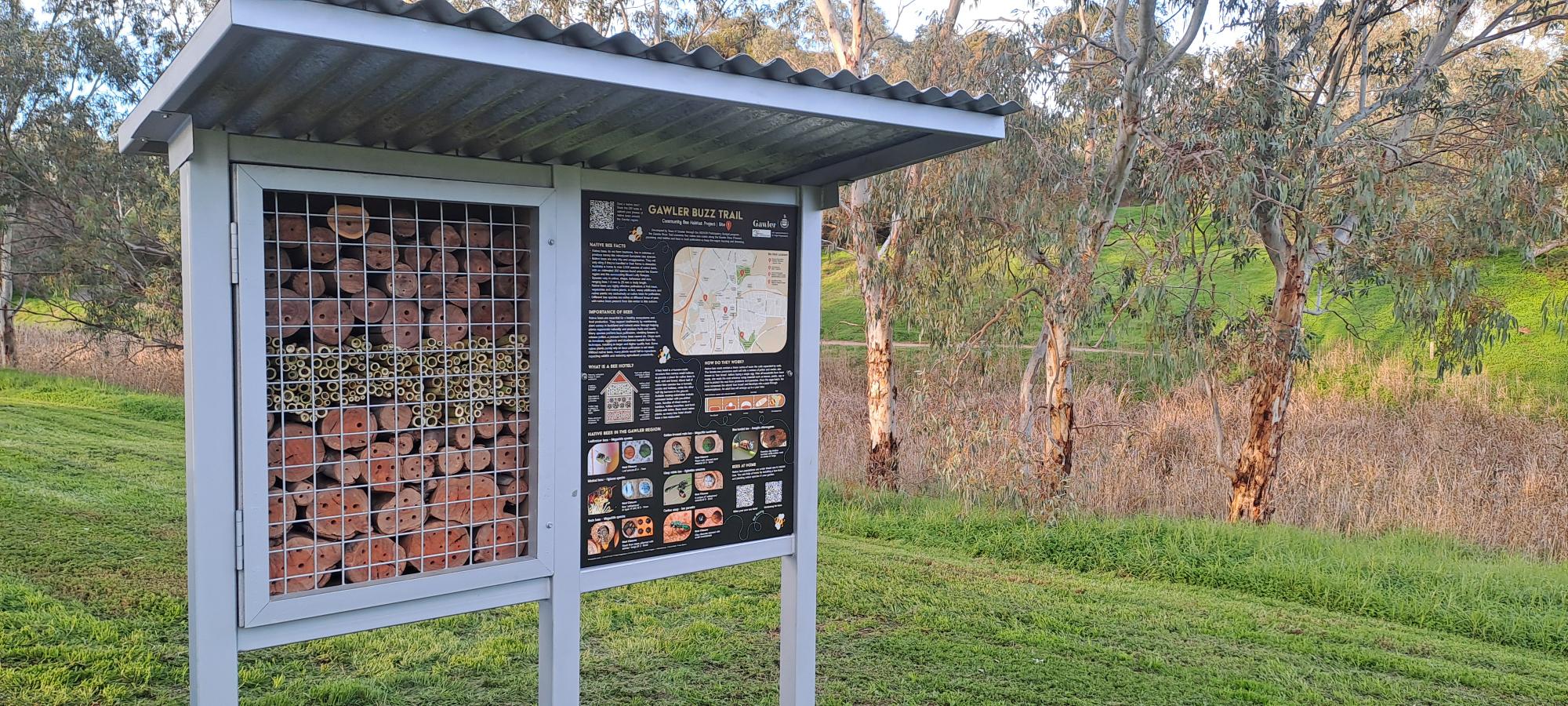
Gawler Buzz Trail
Community Bee Habitat Project
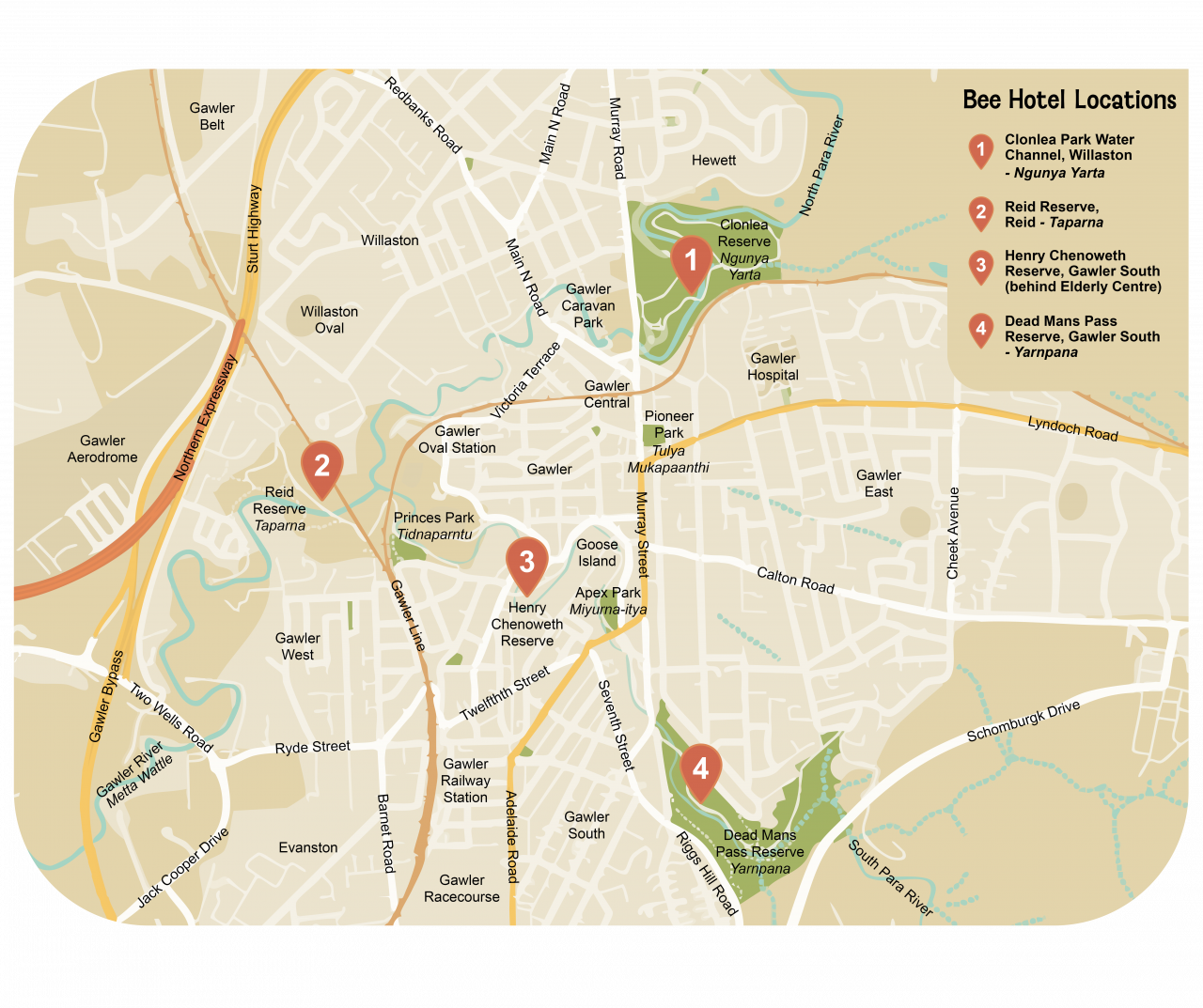
Developed by Town of Gawler through the 2025/26 Participatory Budget program, the Gawler Buzz Trail connects four native bee hotels along the Gawler River Precinct, providing vital habitat and food to local pollinators to keep the region buzzing and blooming.
- Native bees do not form beehives, live in colonies or produce honey like introduced European bee species.
- Native bees are very shy and unaggressive. They will only sting if they’re handled or their home is disrupted.
- Australia is home to over 2,000 species of native bees, with an estimated 300 species found around the Gawler region and the surrounding Mount Lofty Ranges.
- Species vary in colour, shape, behaviour and size, ranging from 1.8 mm to 25 mm in body length.
- Native bees are highly effective pollinators of fruit trees, vegetables and native plants. In fact, many wildflowers and native plants rely exclusively on native bees for pollination.
- Different bee species are active at different times of year, with native bees present from late winter to late autumn.
Native bees are essential for a healthy ecosystems and food production. They support biodiversity by maintaining plant variety in bushland and natural areas through helping plants regenerate naturally and produce fruits and seeds. Many species perform buzz pollination, vibrating flowers to release pollen, a process honey bees cannot do. Crops such as tomatoes, eggplants and blueberries benefit from this technique, resulting in larger and higher quality fruit. Some native plants purely rely on buzz pollination to set seed. Without native bees, many plants would fail to reproduce, impacting wildlife and reducing agricultural productivity.
A bee hotel is a human-made structure that mimics small hollows to provide a place for native bees to nest, rest and breed. About half of native bee species live in tunnels, cracks and hollows, while the other half dig burrows in the ground. Suitable nesting substrates include untreated timber with pre-drilled holes, bundles of dried reeds or bamboo, hollow branches, and mud or brick blocks with holes. Bee hotels work best when surrounded by native plants for bees to pollinate.
Native bee nests contain a linear series of room-like cells separated by walls. The female bee provisions each cell with a mixture of pollen and nectar, also known as ‘bee bread’, before laying a single egg. Once all cells are facilitated with eggs, she seals the nest entrance using material such as leaves, petals, sap or mud to protect the nest from predators and parasites. Once the eggs hatch, the larva consumes the stored ‘bee bread’ and grows into a pupa. Metamorphosis then occurs within the sealed cell, and an adult bee will emerge up to a year later.
- Leafcutter bees - Megachile species
- Masked bees - Hylaeus species
- Resin bees - Megachile species
- Golden-browed resin bee - Megachile aurifrons
- Wasp mimic bee - Hyleoides concinna
- Cuckoo wasp - Chrysididae species
- Blue banded bee - Amegilla chlorocyanea
Native bee populations are under threat due to habitat loss. You can help at home by installing a bee hotel and planting native species in your garden.