The Town of Gawler Climate Emergency Action Plan (CEAP) has been prepared in response to the scientific alarms being sounded all over the world, warning us that our failure to act will result in irreparable damage and an unsustainable pathway for emerging and future generations.
At the Council meeting held on the 22 January 2019, Town of Gawler joined a growing number of Councils in Australia and worldwide in declaring that we are facing a ‘Climate Emergency’ and that urgent action is required by all levels of government. The resolution acknowledges that the Gawler Council Area is likely to be adversely affected by climate impacts, such as heat waves, bushfires, drought and floods according to local data provided by numerous reports and agencies.
The Town of Gawler recognises the importance of leading by example and has developed an action plan to further enhance resilience and reduce climate impacts.

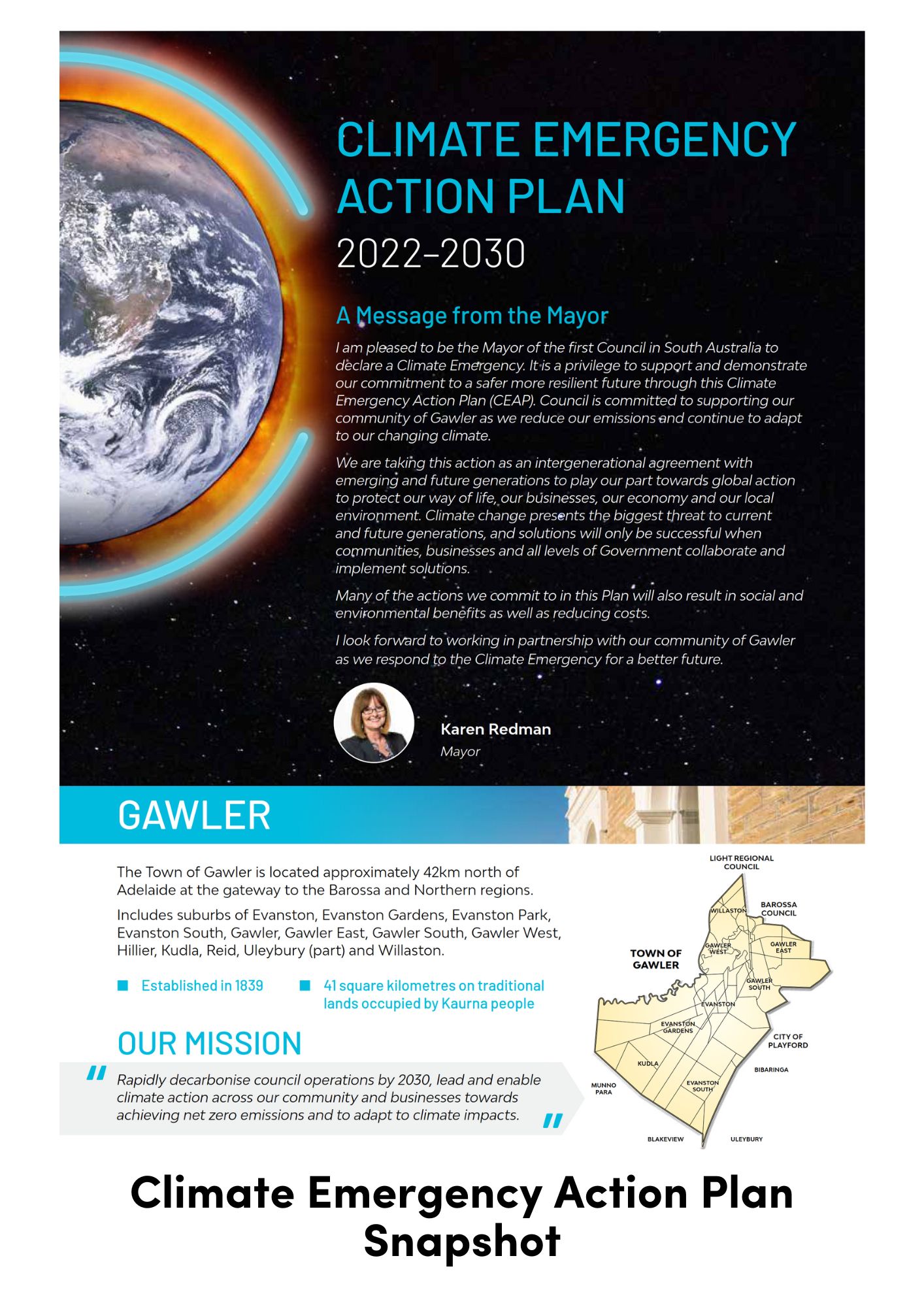
Our Mission
Rapidly decarbonise Council operations by 2030, lead and enable climate action across our community and businesses towards achieving net zero emissions and to adapt to climate impacts.
Key Projects
To achieve our goal of net zero emissions by 2030 and to adapt to climate impacts the Town of Gawler are working on, or have recently undertaken the following projects:
Further info: www.gawlerenvironmentcentre.org.au/event-gawler-repair-cafe
The Town of Gawler Public Lighting Project was undertaken in late 2022 and early 2023. The objectives of the project include reducing electricity consumption and costs, improving the quality of public lighting, reducing greenhouse gas emissions and reducing the cost of maintaining the lights by switching to new tariff arrangements.
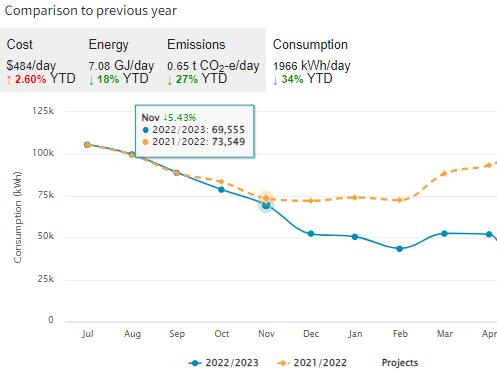
The Project was identified in the Town of Gawler Climate Emergency Action Plan and has already demonstrated significant reductions in electricity consumption by 34% for its public lighting, which has helped offset some of the recent price rises of electricity.
The Gawler Public Lighting Upgrade Project has been successfully completed with the following key project outcomes being realised:
The project has resulted in the following outcomes:
- 1,677 lights have been upgraded to LED technology, reducing electricity consumption and costs.
- 117 Pendant and Post Top lights were confirmed as fitted with LED lamps and did not require an upgrade.
- 808 Pendant and Post Top lights could not be changed without replacing the whole lamp-head at significant cost. Council will continue to explore a solution to modify and upgrade these lights at a lower cost.
- Significant cost savings (direct electricity and asset management) have been achieved, estimated at $135,000 for the 2034/24 financial year.
- The project has improved the quality of public street lighting.
- Significant reductions in electricity consumption and Scope 2 greenhouse gas emissions have been achieved.
The reduction in electricity consumption and associated emissions can be clearly observed in Councils tracking using the Trellis online monitoring application. The below image compares 2022/23 monthly consumption with twelve months earlier:
The Town of Gawler Climate Emergency Action Plan aims to transition to the purchasing of new light vehicles as electric only by 2025 and new heavy vehicles as electric only by 2030. This is an ambitious aspiration considering that to date, our vehicle fleet is made up of petrol, diesel and hybrid vehicles.
In 2022 the Town of Gawler ordered two electric pool cars which are expected to arrive soon. This will enable all employees the opportunity to experience electric vehicle use and become familiar with recharging. We continue to run life cycle cost comparisons and expect that as Council buys new replacement vehicles the transition will increase in pace.
Council provides two charging stations for charging for public electric vehicles, located at the Gawler Visitor Information Centre, 2 Lyndoch Road Gawler and the Gawler Administration Centre, 43 High Street Gawler East.
Resources
Whilst there is further work to do in South Australia towards recycling and remanufacturing electric vehicle batteries, this facility in the USA shows exactly how it will work, even for full size electric vehicle batteries.
Watch Now: https://www.facebook.com/watch?v=706367034685145
In Australia we already have EV battery recycling through companies like ECO0Batt (see https://www.ecobatt.net/) in Melbourne. A national approach has been called for to provide the services required in states and territories.
In 2019, the Town of Gawler installed solar systems on the Gawler Administration Centre and Gawler Sport & Community Centre. Solar electricity systems have since been installed and are operational on the Gawler Civic Centre and the Evanston Gardens Library, with new systems at the Gawler Visitor Information centre and Gawler Elderly Centre having been installed in June 2023.
These add our existing on site generation capacity of to above 200 kW. which provides approximately 15% of Council’s total electricity use coming from on-site renewable electricity.
The Town of Gawler Climate Emergency Action Plan sets ambitious aspirational goals for Council towards net zero emissions but also seeks to enable our community to participate in taking urgent action on climate change. Key areas where we believe that households and small business could take faster action include:
- Greening of Gawler
- Support for greater energy efficiency
- Transitioning to renewable electricity
- Transitioning to electric vehicles powered by renewable electricity
- Transitioning away from gas to electric appliances and processes, powered by renewable electricity
Areas 3, 4 and 5 all relate to renewable electricity and in that context, the Town of Gawler is a strong advocate for reforms so that renewable electricity is available to consumers with greater clarity and fairer pricing that reflects the falling cost of renewable electricity generation.
On 15 September 2025 the Federal Government released two landmark climate change documents.
These are:
- Australia’s first National Climate Risk Assessment – a comprehensive overview of the future nationally significant climate risks and impacts.
- Australia’s National Adaptation Plan – a policy framework to respond to these risks.
Together, these documents provide the key foundations for understanding and responding to climate impacts.
The National Climate Risk Assessment is a new evidence base of best-available information to inform adaptation planning and action. It finds the impacts on Australia are extensive, but the worst-case scenario is not our inevitable future.
The National Adaptation Plan describes the actions required to adapt towards reducing the social, environmental and economic impacts identified in the risk assessment. The National Adaptation Plan provides a vision for a well-adapted Australia.
Both documents can be accessed via the following link:
https://www.dcceew.gov.au/about/news/adapting-to-climate-risk-in-australia-pathway-forward
- Town of Gawler Survey Response – Greenhouse Gas Protocol Market Based Accounting Survey 2023
- Town of Gawler Survey Response – Greenhouse Gas Protocol – Scope 2 Survey 2023
- Town of Gawler Proposal – Greenhouse Gas Protocol – Transition to full market based accounting for Scope 2 Guidance 2023
- Town of Gawler Proposal – Greenhouse Gas Protocol – Method to determine Residual Mix Factors for use in the market based accounting of electricity 2023
- Town of Gawler Proposal – Greenhouse Gas Protocol – Establish a high level ‘No Double Counting Principle’ for all Greenhouse Gas Protocol Standards and Guidance documents 2023
- Town of Gawler Proposal – Greenhouse Gas Protocol – Jurisdictions to underpin Greenhouse Gas Protocol Standards and Guidance accounting 2023
- Town of Gawler Submission to Climate Active Climate 2022
- Town of Gawler Submission to Climate Active Climate on Accounting for Electricity 2020
The Town of Gawler has made the following submissions which are aimed at fair pricing with establishing clear and consistent rules for renewable electricity and carbon offsets for Council and all consumers.
ACCC Consultation on Environment and Sustainability Claims
2024 Proposed Amendments to South Australia’s Climate Change and Greenhouse Gas Emissions Reduction Act 2007
National Greenhouse and Energy Reporting (NGER) Determination
Greenhouse Gas Protocol Review - 2023
Australian Carbon Credit Units Review - 2022
GreenPower Review - 2022
Climate Active – 2020-2022
Corporate Emissions Reduction Transparency Scheme – 2021-2022
Resources kit for industry and business
As an outcome of the 2025 Industry Climate Change Conference, the South Australian Government has released a Resources Kit for businesses to manage climate risks and provide tools to reduce emissions and build climate resilience. The Resources Kit is available the following link and will assist in accessing further information HERE
Current Grants and Rebates Available
Under the $1 billion Household Energy Upgrades Fund, the Clean Energy Finance Corporation (CEFC) will work with lenders to provide discounted finance products to help households upgrade their homes with battery-ready solar PV, modern appliances and other improvements.
To see if you are able to apply through a participating lender, read more about the scheme here:
https://www.energy.gov.au/rebates/household-energy-upgrades-fund
Small businesses can now apply for grants of up to $50,000 to help reduce their energy bills, under Round 2 of the Malinauskas Government’s $154 million Economic Recovery Fund (ERF).
The grants will range from $2,500 to a maximum of $50,000, subject to a matching contribution by the applicant, and will help up to 8000 small businesses invest to reduce their energy costs.
The grants can be used for investments including:
- Purchasing and installing power supply and generation equipment (such as batteries and solar panels)
- Purchasing and installing more energy efficient appliances (above 4-star rating air conditioners, refrigerators, freezers & dishwashers)
- Purchasing/adopting automation technologies that result in greater energy efficiency
- Building improvements to ensure more efficient heating and/or cooling
Businesses can register their interest for round two of the ERF through the Office for Small and Family Business website at business.sa.gov.au
Climate Emergency Action Plan Working Group
2022 Agendas
08-06-2022 - Agenda - CEAP Working Group
11-05-2022 - Agenda - CEAP Working Group
13-04-2022 - Agenda - CEAP Working Group
09-03-2022 - Agenda - CEAP Working Group
2021 Agendas
08-12-2021 - Agenda - CEAP Working Group
13-10-2021 - Agenda - CEAP Working Group
08-09-2021 - Agenda - CEAP Working Group
14-07-2021 - Agenda - CEAP Working Group
09-06-2021 - Agenda - CEAP Working Group
12-05-2021 - Agenda - CEAP Working Group
14-04-2021 - Agenda - CEAP Working Group
17-03-2021 - Agenda - CEAP Working Group
10-02-2021 - Agenda - CEAP Working Group
13-01-2021 - Agenda and Attachments - CEAP Working Group
2020 Agendas
11-11-2020 - Agenda - CEAP Working Group
14-10-2020 - Agenda - CEAP Working Group
16-09-2020 - Agenda - CEAP Working Group
19-08-2020 - Agenda - CEAP Working Group
15-07-2020 - Agenda - CEAP Working Group
18-06-2020 - Agenda - CEAP Working Group
20-05-2020 - Agenda - CEAP Working Group
15-04-2020 - Agenda - CEAP Working Group
26-03-2020 - Agenda - CEAP Working Group
19-02-2020 - Agenda - CEAP Working Group
15-01-2020 - Agenda - CEAP Working Group
15-01-2020 - Attachments - CEAP Working Group
2019 Agendas
18-12-2019 - Agenda - CEAP Working Group
20-11-2019 - Agenda - CEAP Working Group
16-10-2019 - Agenda -CEAP Working Group
18-09-2019 - Agenda - CEAP Working Group
21-08-2019 - Agenda - CEAP Working Group
2022 Minutes
13-04-2022 - Minutes - CEAP Working Group
09-03-2022 - Minutes - CEAP Working Group
2021 Minutes
08-12-2021 - Minutes - CEAP Working Group
13-10-2021 - Minutes - CEAP Working Group
08-09-2021 - Minutes - CEAP Working Group
14-07-2021 - Minutes - CEAP Working Group
12-05-2021 - Minutes - CEAP Working Group
14-04-2021 - Minutes - CEAP Working Group - Amended
14-04-2021 - Minutes - CEAP Working Group
17-03-2021 - Minutes - CEAP Working Group
10-02-2021 - Minutes - CEAP Working Group
13-01-2021 - Minutes - CEAP Working Group
2020 Minutes
11-11-2020 - Minutes - CEAP Working Group
14-10-2020 - Minutes - CEAP Working Group
16-09-2020 - Minutes - CEAP Working Group
19-08-2020 - Minutes - CEAP Working Group
15-07-2020 - Minutes - CEAP Working Group
18-06-2020 - Minutes - CEAP Working Group
20-05-2020 - Minutes - CEAP Working Group
15-04-2020 - Minutes - CEAP Working Group
26-03-2020 - Minutes - CEAP Working Group
19-02-2020 - Minutes - CEAP Working Group
15-01-2020 - Minutes - CEAP Working Group
2019 Minutes
18-12-2019 - Minutes - CEAP Working Group
16-10-2019 - Minutes - CEAP Working Group
18-09-2019 - Minutes - CEAP Working Group
21-08-2019 - Minutes - CEAP Working Group
Click here to view the Town of Gawler’s Environmental Management Framework 2026-2028, which outlined our initials strategies and to address climate change.
Click here to sign up to Regional Development Australia – Yorke and Mid North RDAYMN Monthly Business E-Newsletter for updates on grants which often includes climate and resilience grant opportunities.